• Joining Forces to Shape a New Intelligent Manufacturing Ecosystem: Kardex and Heli Yufeng Enter Strategic Partnership
    Joining Forces to Shape a New Intelligent Manufacturing Ecosystem: Kardex and Heli Yufeng Enter Strategic Partnership Jan 26, 2026
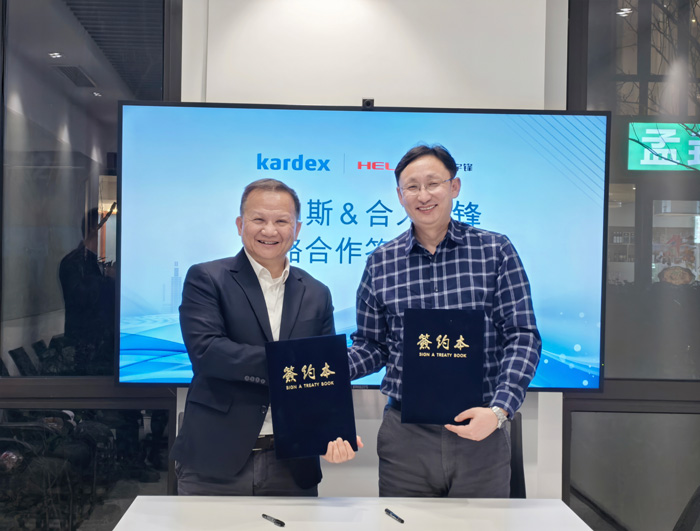
    December 15, 2025 — Kardex, a global leader in intralogistics automation, and Anhui Heli Yufeng Intelligent Technology Co., Ltd. (Heli Yufeng), a national “Sci-Tech Reform Demonstration” enterprise, officially signed a strategic cooperation agreement at Kardex’s Shanghai headquarters. The two parties will establish a joint brand, marking a new chapter in the deep integration of German and Chinese technologies in intelligent logistics. A Century of German Engineering × A Pioneer of China’s Intelligent Manufacturing Founded in 1873, Kardex has continuously set industry benchmarks. Since launching the world’s first automated storage system in 1957, Kardex has delivered over 200,000 systems worldwide, serving customers in more than 30 countries and holding a leading position in automated high-density storage. Heli Yufeng, a holding subsidiary of Anhui Heli Co., Ltd., has been recognized as a National High-Tech Enterprise, a national “Little Giant” specializing in niche technologies, and a recommended brand in China’s intelligent logistics sector. Centered on four core businesses—intelligent warehousing, intelligent handling, intelligent factories, and intelligent parks—Heli Yufeng leverages nearly 70 years of Heli Group’s technical expertise to build a comprehensive portfolio covering logistics robots, AMRs, intelligent integration systems, and digital twin platforms. The company has delivered benchmark projects across industries including new energy, chemicals, food & cold chain, automotive, metallurgy, and semiconductors. Complementary Technologies for End-to-End Solutions This partnership focuses on deep synergy. Kardex will contribute its proven vertical lift modules and carousel storage systems, while working with Heli Yufeng and Heli Group’s global network of over 1,000 sales and service organizations. Together, they will provide customers with full-lifecycle, one-stop intelligent logistics solutions—covering consulting, planning, product development, implementation, delivery, and after-sales service. Industry Synergy, Expanding Key Markets Kardex brings strong expertise in machinery manufacturing, semiconductors, aerospace, and healthcare, while Heli Yufeng has deep roots in new energy, chemicals, food cold chain, and automotive parts. By integrating industry know-how and channel resources, the two companies will jointly advance benchmark projects in high-end manufacturing, semiconductors, cold chain logistics, and new energy sectors. Executive Perspectives Jeffrey Cha, Head of Kardex China, commented: “Heli Yufeng’s strong localization capabilities and industry reach will help us deliver our world-leading technologies to Chinese customers more efficiently.” Li Daoliang, Party Secretary, Chairman, and General Manager of Heli Yufeng, added: “Kardex’s global technology vision and product reliability will significantly enhance the competitiveness of our joint solutions.” Moving Forward Together As China’s manufacturing sector accelerates its ...
    View More

  • Winning Two Top Honors | HELI YUFENG Secures Two Prestigious Awards in Intelligent Logistics
    Winning Two Top Honors | HELI YUFENG Secures Two Prestigious Awards in Intelligent Logistics Jan 19, 2026
    From December 11–12, the 13th Global Intelligent Logistics Industry Development Conference was held in Suzhou under the theme “Understanding Change, Returning to the Core, and Building a Win-Win Ecosystem.” The event brought together industry experts, corporate leaders, and ecosystem partners to explore trends and real-world practices in intelligent logistics. With its comprehensive full-stack capabilities spanning product strength, solution design, technological innovation, platform development, and service delivery, HELI YUFENG stood out among peers and won two major awards. This achievement further strengthens its industry position and brand influence, highlighting strong and sustained growth momentum in the intelligent logistics sector. Insight into Industry Transformation: Redefining Logistics Scenarios with AI Logistics Robots At the main forum, Shao Meng, Strategic Marketing Director of HELI YUFENG, delivered a keynote speech titled “Redefining New Logistics Scenarios with AI Logistics Robots.” Drawing on the company’s full-scenario, full-stack intelligent logistics solutions and integrated service model, he shared in-depth insights into the industry value, product solutions, core technologies, and application scenarios of AI logistics robots. He emphasized that AI logistics robots serve as the intelligent foundation of modern logistics. Their scenario-based deployment will drive a paradigm shift, turning “data-driven logistics” into reality. Powered by AI + advanced technologies, warehouse robots and mobile robots are evolving from “fixed automation” to a more intelligent and proactive mode. This transition expands and upgrades existing automation scenarios, helping enterprises rapidly build new-quality productive forces, accelerate digital and intelligent transformation, and achieve sustainable operational value—while also supporting industrial upgrading and new industrialization. Authoritative Industry Recognition: Dual Honors for Brand and Leadership At the 2025 Annual Awards Ceremony held concurrently, HELI YUFENG once again received the “Outstanding Brand in the Intelligent Logistics Industry” award. Backed by a thousand-strong, full-chain service team and its strengths in high-standard products, advanced technologies, scientific solutions, systematic delivery, and premium services, the company earned strong recognition from the industry. This honor not only affirms its technological and innovative capabilities but also reinforces its leading position and market influence. Meanwhile, Li Daoliang, Party Secretary, Chairman, and General Manager of HELI YUFENG, was named “Outstanding Figure in the Intelligent Logistics Industry.” As the company’s strategic leader, he has guided HELI YUFENG with a forward-looking vision and decisive execution. In 2025, under his efficient and high-quality leadership, the company achieved breakthrough growth in orders and revenue, continued to lead the industry with new products and technologies, accelera...
    View More
  • Tens-of-Thousands-Ton Smart Cold Storage Goes Live — A New Benchmark for Xinjiang’s Cold Chain Logistics
    Tens-of-Thousands-Ton Smart Cold Storage Goes Live — A New Benchmark for Xinjiang’s Cold Chain Logistics Sep 10, 2025
    Project Overview Located in the heart of Urumqi-Changji, this international food hub integrates three functional zones: a central kitchen, a cold chain logistics park, and an innovation incubator. The cold chain logistics park is equipped with China’s most advanced automated cold storage technology, combined with a one-stop warehousing and distribution system. Leveraging its prime location, the hub also supports supply chain finance, import/export trade, and serves both domestic and international markets. At the core, a -25°C automated high-bay cold storage facility has been built, powered by HELI Yufeng’s intelligent cold chain warehousing solution. This enables ultra-dense storage and modernized warehouse management. Partnering with HELI Yufeng to Set a New Standard The solution covers inbound, storage, and outbound processes. At its center are 12 curve-rail stacker cranes, RGV conveyor systems, and high-speed wrapping machines—together offering ~50,000 pallet positions. All equipment is designed to operate stably at -25°C, maximizing space utilization and efficiency. Highlight 01 — Low-Temperature-Ready Equipment To withstand -25°C, all equipment was custom-engineered. The stacker cranes are built with low-temperature-resistant steel to avoid cold brittleness. Motors use cold-resistant designs, gearboxes are filled with specialized lubricants, and all electrical components are selected for sub-zero reliability. Since visibility in cold storage is limited due to fog and frost, traditional laser positioning is ineffective. Instead, barcode scanners and coded tape are used to ensure precise navigation. Highlight 02 — Curve-Rail Stacker Cranes + Dual-Car RGV The project uses double-deep curve-rail stacker cranes, which can flexibly switch between aisles, cutting down on hardware investment. The RGV system is designed with “one track, two cars.” If one car goes down, the other keeps running—ensuring continuous operation. Impact & Benefits Smarter Management & Full Traceability From the loading dock, all key data—temperature, humidity, and transport routes—are tracked in real time. This enables full lifecycle traceability, boosting food safety, consumer confidence, and providing valuable data for digital upgrades. Maximized Storage Capacity With a 20-meter-high design, the system doubles storage density compared to traditional cold storage of the same footprint, while significantly cutting energy and cooling costs. Lower Labor Costs & Better Working Conditions Automation minimizes manual work in harsh -25°C environments, reducing labor costs and keeping staff out of extreme conditions—improving both safety and efficiency. Dual Role: Daily Supply + Emergency Response Beyond daily cold chain operations, the facility also strengthens emergency storage and rapid distribution capabilities—ensuring reliable support for regional stability and economic growth. A Modern Cold Chain Hub for Xinjiang The project’s launch marks a major step in upgrad...
    View More
  • How to Solve the “Disorganized” Automotive Glass Tooling Management Problem with One Click?
    How to Solve the “Disorganized” Automotive Glass Tooling Management Problem with One Click? Aug 14, 2025
    According to the Global and China Automotive Glass Industry Market Status Research and Development Prospect Analysis Report (2025–2030), the global automotive glass market reached RMB 114.072 billion in 2023 and is expected to exceed RMB 149.2 billion by 2025. From 2020 to 2025, the compound annual growth rate is projected to reach 11%, far exceeding the average level of traditional manufacturing industries, showing a strong growth trend. Automotive Glass Industry Challenges: From Production Technology to Management Upgrades Against the backdrop of rapid market expansion, automotive glass manufacturers must not only continuously optimize production technology but also upgrade production support and management processes. In particular, the management of molds, inspection tools, and non-standard tooling equipment—critical for ensuring stable production lines and smooth operations—has become a key link between production demands and delivery schedules. The efficiency and accuracy of tooling management directly impact delivery cycles and service quality, making it a core factor in enhancing enterprise competitiveness. EFORK Intelligence Helps Industry Leaders Achieve Smart Warehousing A leading global integrated glass manufacturer, with years of expertise in high-quality float glass, automotive glass, and energy-efficient architectural glass, has built an integrated industrial chain covering raw material procurement, glass production, deep processing, manufacturing, and sales. To further improve automotive glass tooling warehouse management, ensure product forming quality, increase production plan completion rates, and shorten delivery cycles, the company introduced EFORK’s Intelligent Automotive Glass Tooling Smart Warehousing Solution. This solution integrates an automated storage and retrieval system (AS/RS), RGV (Rail-Guided Vehicle) shuttles, and WMS/WCS intelligent logistics systems, enabling end-to-end automated management of molds and inspection tools from production to use at the bending furnace—effectively overcoming multiple bottlenecks of traditional warehousing. Key Issues in Traditional Warehouse Management Low space utilization and limited storage capacity Molds and inspection tools are large and irregularly shaped. Traditional horizontal or floor stacking wastes a significant amount of vertical space. With increasing orders and frequent product changes, limited capacity can no longer meet production needs, causing site congestion and obstructing material flow. Low handling efficiency, high labor dependency, and safety hazards Manual or forklift handling in traditional warehouses makes transporting large tooling cumbersome and time-consuming. Especially after the bending furnace process, tooling remains hot, posing burn risks and potential equipment damage, while delays in manual scheduling disrupt production rhythms. Difficult positioning, disorganized management, and delayed information With a wide variety of tooling and complex numb...
    View More
  • How to Store Hazardous Chemicals and Manage Multiple Categories? How EFORK Solves Petrochemical Logistics and Storage Challenges
    How to Store Hazardous Chemicals and Manage Multiple Categories? How EFORK Solves Petrochemical Logistics and Storage Challenges Jul 28, 2025
    As the oil and petrochemical industry enters a critical phase of high‑quality development, green transformation, decarbonization and intelligent upgrades have become the core drivers of innovation. Against the backdrop of China’s ongoing “dual‑carbon” strategy and ever‑growing demands for safety and efficiency, the China Refining & Chemical Enterprise Technology Exchange Conference convened in Beijing on July 24, 2025, bringing together leading petrochemical companies to explore technological innovation and future pathways. Invited as a premier smart‑logistics integrator and high‑end equipment manufacturer, EFORK presented “Applications of Intelligent Warehouse & Logistics Systems in Petrochemicals.” Focusing on core pain points—hazardous‑chemical management, safety and control, high‑density storage and efficient handling—EFORK illustrated industry challenges and transformation needs through typical case studies. From a product‑type perspective, petrochemical materials fall into two main categories—liquids and solids—with distinct packaging, storage methods and logistics workflows: Liquid products (e.g. base oils, lubricants, chemical solvents) are stored in tanks or drums. Their logistics process covers automatic packaging, intelligent palletizing, intermediate buffering, inbound management, storage monitoring, outbound operations and shipment scheduling, all under stringent requirements for leak prevention, corrosion resistance and explosion safety. Solid products (e.g. pellets, powders, resins) are typically bagged and handled on pallets. As production scales and management becomes more refined, solid‑product storage is rapidly shifting toward smart AS/RS (automated storage and retrieval systems) that integrate conveyors, stacker cranes and RGV/AGV to achieve high‑density storage and swift turnover. To address the petchem industry’s diverse storage forms, strict safety requirements and high efficiency demands, EFORK leverages big data, IoT and AI to build a fully automated, intelligent logistics system spanning inbound → storage → transfer → outbound → dispatch: For liquids, EFORK deploys intelligent palletizers, automated conveyors and drum/tank inbound lines, with explosion‑proof robots, temperature‑humidity monitoring and intrinsic‑safety sensors to ensure end‑to‑end safety and control. For solids, EFORK’s smart warehouse solution uses AS/RS, stacker cranes, conveyors and RGV/AGV to deliver high‑density storage, rapid turnover and batch‑flexible in‑out operations, helping clients overcome space constraints and boost warehouse efficiency. Integrated WMS, WCS and EFMS platforms provide real‑time monitoring, intelligent scheduling and collaborative optimization across multiple sites—achieving data‑driven, visualized operations and enhancing safety, control and supply‑chain synergy for petrochemical enterprises. 1. Safe Storage & Compliance of Hazardous Chemicals – Project: AS/RS for hazardous chemicals at an optoelectroni...
    View More
  • From Traditional Manufactring to Intelligent Production: EFORK Empowers Digital Transformation In The Toy Industry
    From Traditional Manufactring to Intelligent Production: EFORK Empowers Digital Transformation In The Toy Industry Jul 25, 2025
    Toy manufacturing is labor‑intensive and increasingly plagued by workforce shortages, complex material management and imprecise preparation. Fierce market competition means that growth by simply hiring more staff or expanding facilities is no longer sustainable. To thrive long‑term, companies must embrace digital and intelligent upgrades. Part 1 -- Industry Challenges Long Lead Times: Order‑to‑shipment cycles range from 40 to over 90 days, missing the key sales window and driving up carrying and storage costs. Inefficient Material Handling: Workers consolidate dozens of material types manually, leading to chaotic staging, low throughput and frequent errors. Labor Shortages: Skilled operators for production and material movement are scarce, jeopardizing continuous operation and inflating labor costs. EFORK One‑Stop Logistics Solution by integrating cutting‑edge automation with advanced logistics equipment, delivers flexible, fully automated workflows—from raw materials through to finished goods. Our turnkey package, featuring an automated warehouse, AGVs and a unified dispatch system, seamlessly links with MES/ERP platforms to build a highly efficient, end‑to‑end intelligent ecosystem. Part 2 -- Project Case Case Study 1: Partnering with a Leading Chinese Sci-Tech Toy Manufacturer Our client is a leading national brand in educational robots and sci-tech toys for ages 0–18. Their core vision is to build a “super factory” of Chinese brick toys surpassing LEGO. Located in Hefei, their new-generation intelligent manufacturing base is a purpose-built “super factory” spanning three floors, with warehousing deeply integrated alongside production lines. Due to the vast variety of materials and semi-finished products distributed across multiple floors, traditional manual operations faced heavy workloads, low efficiency, and management difficulties. Based on our professional solution design, implementation experience, and overall strength, the client engaged EFORK to upgrade their Hefei facility under four core principles: transparency, automation, lean operation, and intelligence. To meet diverse scenarios, EFORK deployed a clustered-robot approach to create an end-to-end, cross-floor, cross-zone integrated solution—driving “intelligent” toy production from warehouse to production line. Solution Highlight 1: Cross-Elevator, Cross-Zone Integration AGVs communicate automatically with six on-site elevators, enabling semi-finished goods storage and finished-goods retrieval between the first and third floors, as well as semi-finished packaging returns from the second to the third floor. Solution Highlight 2: Multi-Model High-Efficiency Collaboration Tugger AGVs and stacker AGVs work together to automate finished goods inbound and outbound processes. Under the EFMS dispatch system, multiple vehicles coordinate efficiently: tugger AGVs move finished products from the offline station to the third-floor staging area via elevator, while stacker AGVs transport g...
    View More
  • From Chaos to Efficiency: Unveiling the Intelligent and Lean Transformation of Automotive Safety Component Manufacturing
    From Chaos to Efficiency: Unveiling the Intelligent and Lean Transformation of Automotive Safety Component Manufacturing Jun 24, 2025
    Amid the ongoing wave of automotive intelligence and electrification, safety—long regarded as a fundamental performance cornerstone—is being redefined. A leading intelligent automotive safety component manufacturer remains deeply rooted in the field of passive safety, with a strong focus on core products such as airbags. In response to surging orders, increasingly complex materials, limited space, and fragmented information, the company faces mounting pressure to break away from traditional manufacturing models. By embracing intelligent solutions, it aims to address dual challenges in production and logistics, significantly enhancing delivery efficiency and overall operational performance. Unclear Task Assignment and Low Collaboration Efficiency A disconnect between production planning and execution, coupled with unclear task assignment processes, leads to poor visibility over job priorities and resource allocation on the shop floor. As a result, collaboration becomes inefficient and response times are delayed, disrupting the overall rhythm of the production line. Disorganized Order Management and Heightened Delivery Risks The absence of a unified order management and traceability system results in delayed status updates and misalignment between material preparation and shipment schedules. This compromises delivery accuracy and erodes customer satisfaction. Inventory Backlog and Severe Resource Occupation Inefficient material flow and mismatches between replenishment and consumption create imbalanced inventory structures. The coexistence of excessive raw materials and stagnant finished goods not only consumes valuable warehouse space but also drives up management and operational costs. To address the above challenges, the company partnered with EFORK to develop a smart factory project that integrates raw material storage, production lines, and intra-factory logistics. The project centers on core equipment including an automated storage and retrieval system (AS/RS), conveyor system, and a PTL (Pick-to-Light) system. Material delivery is handled collaboratively by CTU robots and omnidirectional latent AGVs, enabling fully automated material picking and loading. Finished product dispatch is integrated with an automated packaging system, ensuring seamless information sharing and full traceability across the flow of raw materials, semi-finished products, and finished goods, as well as auxiliary materials. By reinforcing data integration, full-process automation, and site-wide digitalization, the factory has achieved real-time visibility and intelligent management, significantly improving operational efficiency and decision-making precision—paving the way toward high-efficiency intelligent transformation. In response to rising raw material prices and increasing labor costs, the manual picking process posed challenges such as frequent errors and low efficiency. To address this, EFORK implemented a solution combining the PTL system with CTU tote-handling...
    View More
  • From Warehouse to Production Line, Seamless Coordination: A New Smart Logistics Model for the Printing and Packaging Industry
    From Warehouse to Production Line, Seamless Coordination: A New Smart Logistics Model for the Printing and Packaging Industry May 05, 2025
    Survival Challenges for Print and Packaging Enterprises Amidst the Digital Transformation Wave The printing industry's vast product range and complex workflows make automation upgrades and warehouse–logistics integration particularly difficult. In packaging printing, raw materials, semi‑finished goods and finished products must shuttle constantly between pre‑press, press and post‑press stages, yet reliance on manual forklifts today leads to low efficiency, chaotic line‑side storage and lengthy verification times. Rising labor costs and quality issues from human handling only exacerbate the problem, making an intelligent transformation imperative. One leading high‑end packaging manufacturer—whose portfolio spans luxury cosmetics, perfumes, premium spirits and cultural goods—has long held an industry‑leading position and earned the trust of many top global brands, even winning the printing world's "Oscar", the Benny Award. Current Situation 1: Space Planning The printing‐and‐packaging sector handles many large, varied items—raw paper rolls, cartons, bags, etc.—yet the on‑site storage near the shop floor uses flat racking without zoning by paper type, width or grade. This leads to stockpile backlogs, time‐consuming searches for materials, and poor support for efficient production supply and turnover. Current Situation 2: Information Management Throughout production—from raw and auxiliary materials, to semi‑finished and finished goods—there’s no digital or automated management system. All inventory records are handwritten, and data travels via paper cards, making errors inevitable, breaking the data chain and preventing any traceability of product quality. Current Situation 3: Distribution Operations All workshop logistics—internal deliveries and warehouse in/out—are done by hand. Without smart delivery equipment or automated slot management, workers must hunt for items manually, resulting in low delivery efficiency and high labor intensity. Current Situation 4: Environmental Requirements Raw paper and finished paper products are flammable, prone to spoilage and moisture deformation. They must be stored in a dry, clean environment with controlled temperature and humidity, never in high‑heat or high‑pressure areas. Otherwise, friction can build static and pose a serious fire risk. A Tailored Smart Warehousing & Logistics Solution for Packaging & Printing We design and customize an end‑to‑end intelligent logistics system around your actual production logistics and storage needs—covering everything from raw materials and work‑in‑progress to finished goods and consumables. By integrating automated inbound/outbound handling, storage optimization, distribution, and digital data capture and management, this has become one of the industry’s most effective smart‑logistics templates and a benchmark for intelligent manufacturing in printing and packaging. This project spans multiple zones—cutting, printing, screen‑printing, laminating, folding/gluing, r...
    View More
1 2 3 ... 17

A total of 17 pages

Leave A Message
Leave A Message
If you are interested in our products and want to know more details,please leave a message here,we will reply you as soon as we can.

Home

Products

about

contact